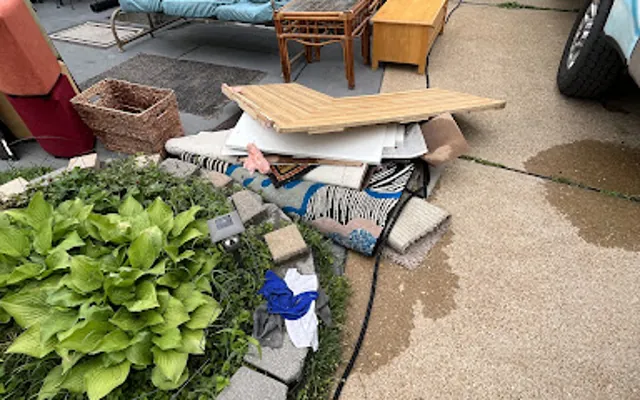
A break in an aging city main or the private line running from the street to the house can send water across a yard, into a garage, or up against a slab foundation before anyone can shut it off. Crews respond quickly to extract water and check how far it traveled into the structure.

The line is shut off at the meter or curb valve where possible to stop the flow while the break itself is reported to BWP or a qualified plumber.
Water pooled in a garage, crawlspace access, or against the foundation is pulled with extraction equipment before it seeps further into the structure.
Moisture meters check slab edges, garage walls, and any interior areas the water may have reached to confirm the extent of intrusion.
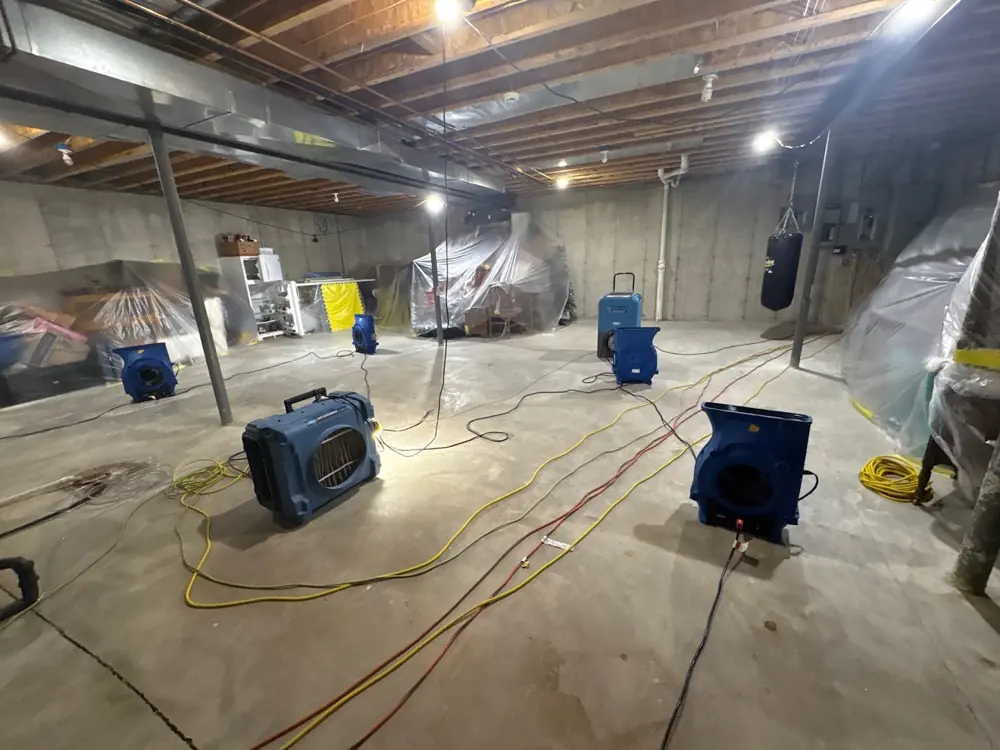
Air movers and dehumidifiers are staged where needed, and moisture readings are logged daily along with photos for the insurance or municipal claim.

While help is on the way, these first steps, done only where it is safe, limit the damage and protect the insurance claim.
Shut the supply off at the source, or close the home's main valve if the source is not obvious. Stopping the flow limits the damage more than anything else.
Switch off electricity to the affected area, but only if the breaker can be reached without standing in or touching the water.
Get a crew dispatched right away. The sooner extraction and drying begin, the more flooring, drywall, and belongings can be saved.
Take photos and a short video of the water and the affected rooms before anything is moved, so the insurance claim starts strong.
Cleanup limited to a garage or exterior area after a main or service line break typically runs from about $500 to $1,800, mainly extraction and drying of the affected space. If water pushed into the structure itself, soaking drywall, flooring, or insulation, the range moves toward $2,500 to $7,000 depending on how many rooms were affected. Damage from a city main failure may be eligible for a municipal claim rather than homeowners insurance, and moisture documentation is kept detailed enough to support either path.
Crews reach Burbank, Glendale, and the San Fernando Valley fast, from the Rancho District, Burbank Hills, and Magnolia Park to North Hollywood, Studio City, and Pasadena. See the full list on the areas served across Burbank page.
See all areas servedEvery loss is photographed, measured, and logged from the first visit, so the paperwork holds up with the insurance carrier.
Technicians follow recognized IICRC drying standards and prove it with daily moisture readings on Burbank homes, not guesswork.
Emergency dispatch any hour of the day or night, with a real crew on the way across the San Fernando Valley, not a callback in the morning.
A real crew dispatched any hour, not a callback in the morning.
Trained technicians following recognized IICRC drying standards.
Truck-mounted, portable, and submersible for any size loss.
The loss is documented and billed to the carrier directly.
Burbank Water and Power maintains the main up to the meter. A break before the meter is typically the city's responsibility, while a break between the meter and the house falls to the property owner and a qualified plumber.
It depends on where the break occurred and the policy language. Damage from a private service line failure is often covered, while a public main break may fall under a municipal claim process instead.
It depends on grade and proximity, but on a sloped Burbank lot near the hills, water can reach a garage or foundation within minutes of a break, which is why fast extraction matters.
Prolonged saturation against a foundation can be a concern, which is why moisture readings are taken along slab edges even when the interior looks unaffected.
Burbank Water and Power handles main line breaks in the public system. A qualified plumber handles the private service line between the meter and the home.
Burbank crews are on call 24 hours a day, local and fast, and can be on the way within the hour.
Call (747) 977-8570