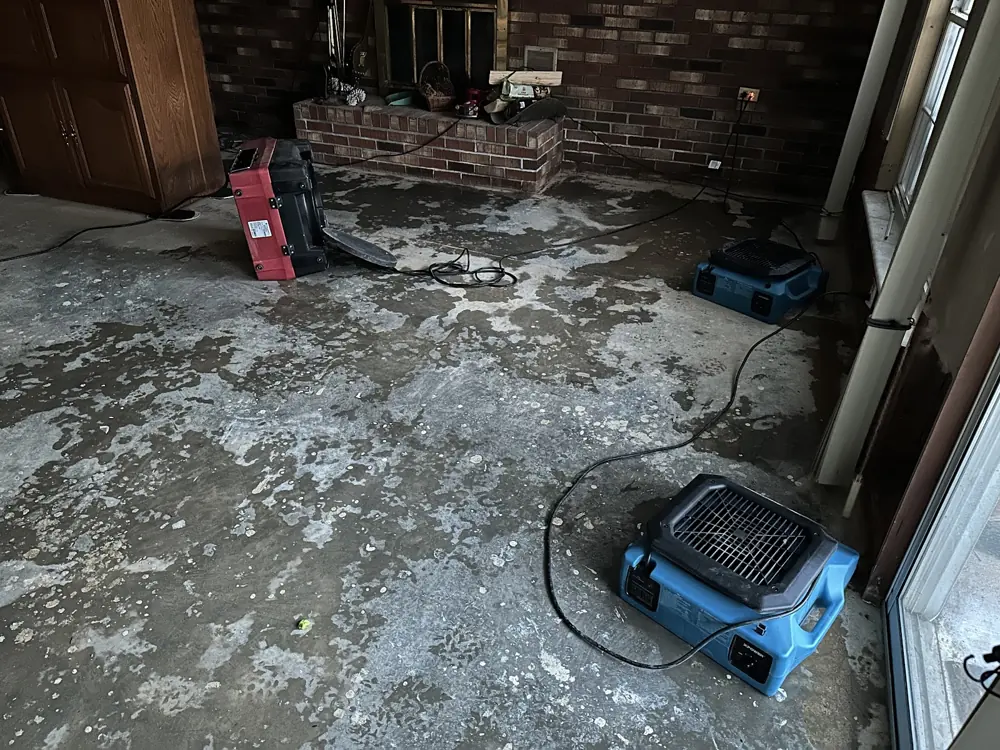
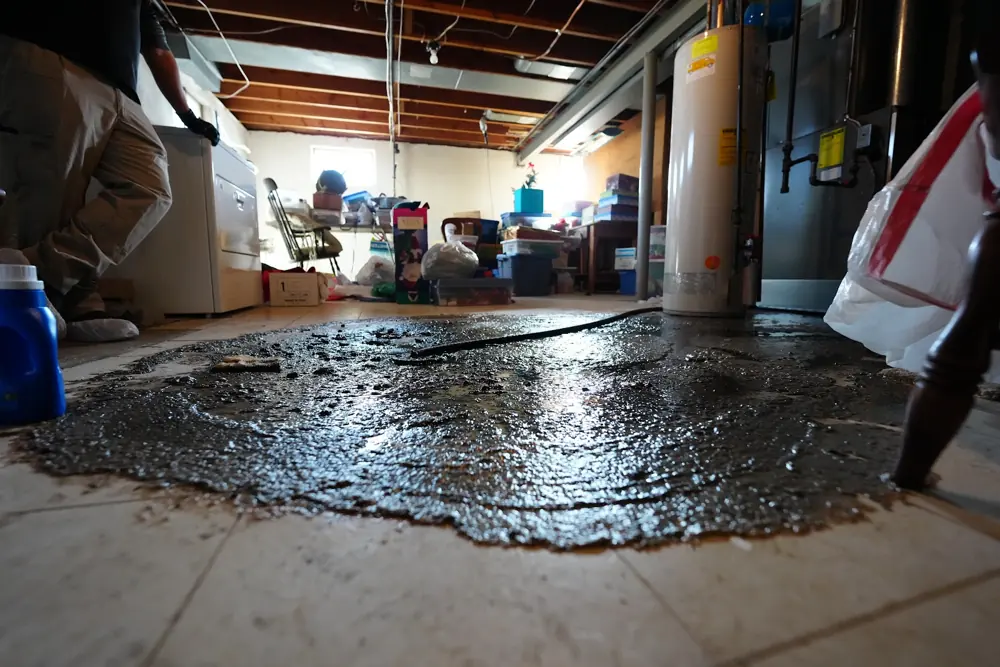
Most Burbank garages sit right at grade on a concrete slab, with a door seal as the only real barrier against a heavy winter storm, and many double as laundry rooms or storage that puts belongings directly in the path of any water that gets in. Crews extract standing water fast and check what it reached before mold becomes the bigger problem.

The cause, storm intrusion under the door, a laundry appliance failure, or another source, is confirmed so the right fix is recommended alongside cleanup.
Pooled water on the slab is extracted quickly, since a bare concrete garage floor holds standing water differently than carpeted living space.
Items sitting on the slab are checked and moved, since cardboard and untreated wood absorb water fast and are often the first materials lost.
Air movers and a dehumidifier dry the slab and any adjoining drywall, with moisture readings confirming the space is dry before items are returned.

While help is on the way, these first steps, done only where it is safe, limit the damage and protect the insurance claim.
Shut the supply off at the source, or close the home's main valve if the source is not obvious. Stopping the flow limits the damage more than anything else.
Switch off electricity to the affected area, but only if the breaker can be reached without standing in or touching the water.
Get a crew dispatched right away. The sooner extraction and drying begin, the more flooring, drywall, and belongings can be saved.
Take photos and a short video of the water and the affected rooms before anything is moved, so the insurance claim starts strong.
Garage water damage limited to standing water on a bare slab, caught within a day, typically runs from about $300 to $900 for extraction and drying. If water reached drywall, stored belongings, or a laundry area with appliances, the range moves toward $1,200 to $3,500 depending on how much has to be dried, discarded, or replaced. Storm intrusion and sudden appliance failures are commonly covered by homeowners insurance, with moisture readings and photos of affected belongings documented for the claim.
Crews reach Burbank, Glendale, and the San Fernando Valley fast, from the Rancho District, Burbank Hills, and Magnolia Park to North Hollywood, Studio City, and Pasadena. See the full list on the areas served across Burbank page.
See all areas servedEvery loss is photographed, measured, and logged from the first visit, so the paperwork holds up with the insurance carrier.
Technicians follow recognized IICRC drying standards and prove it with daily moisture readings on Burbank homes, not guesswork.
Emergency dispatch any hour of the day or night, with a real crew on the way across the San Fernando Valley, not a callback in the morning.
A real crew dispatched any hour, not a callback in the morning.
Trained technicians following recognized IICRC drying standards.
Truck-mounted, portable, and submersible for any size loss.
The loss is documented and billed to the carrier directly.
Slab-on-grade garages sit close to the surrounding grade, and a worn door seal or a driveway that channels water toward the door can let a heavy storm in even without broader neighborhood flooding.
It depends on the material and how long it sat wet. Cardboard and particleboard are usually a loss quickly, while plastic totes, metal, and some furniture can often be dried and kept.
Bare concrete does not absorb water the way carpet does, but a saturated slab can still hold moisture that affects drywall, stored items, or a laundry area, so it is still checked with a moisture meter.
Sudden storm intrusion or an appliance failure is commonly covered. Coverage for stored personal belongings can vary, so photo documentation of the items involved is kept for the claim.
Storm water entering under a worn door seal during heavy winter rain and laundry appliance failures in garages that double as a laundry room are the two most common causes locally.
Burbank crews are on call 24 hours a day, local and fast, and can be on the way within the hour.
Call (747) 977-8570