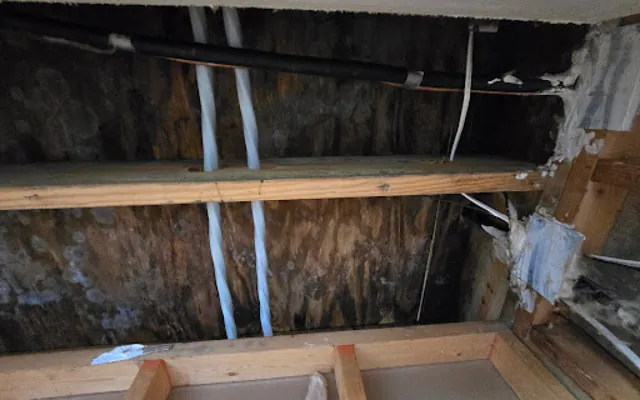
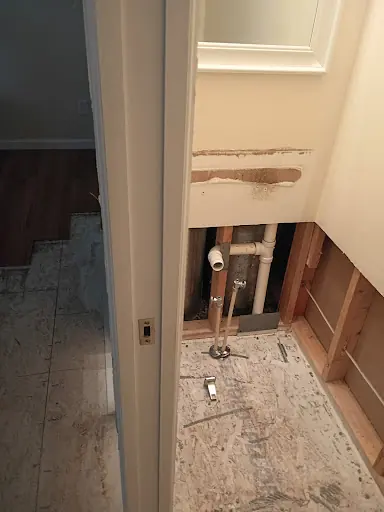
Burbank's long dry summers let roof sealant, flashing, and tile underlayment crack and shrink before winter storms test them, and once rain gets past that first weak point it can travel a surprising distance before showing up as a ceiling stain. Crews respond 24/7 to dry the damage and document it for the claim.

A crew arrives in about an hour and traces the water back from the visible ceiling or wall stain toward the actual roof entry point, which is often several feet away.
If water has pooled in a ceiling cavity or attic insulation, a controlled opening releases it safely and any standing water below is extracted.
Saturated drywall, insulation, and any affected framing surfaces are removed or treated so trapped water is not sealed inside once repairs begin.
Drying equipment brings the area to a verified moisture target while a qualified roofer addresses the actual leak point, with everything documented for the insurance claim.

While help is on the way, these first steps, done only where it is safe, limit the damage and protect the insurance claim.
Shut the supply off at the source, or close the home's main valve if the source is not obvious. Stopping the flow limits the damage more than anything else.
Switch off electricity to the affected area, but only if the breaker can be reached without standing in or touching the water.
Get a crew dispatched right away. The sooner extraction and drying begin, the more flooring, drywall, and belongings can be saved.
Take photos and a short video of the water and the affected rooms before anything is moved, so the insurance claim starts strong.
Roof leak water damage cleanup in Burbank typically runs from about $600 to $3,000, depending on how far the water traveled before showing up and how much ceiling, insulation, and framing surface needs attention. A small, recently discovered stain sits on the low end, while damage from a leak that ran through several storms before being found sits on the high end. The water damage cleanup portion is commonly covered under a homeowner policy, while repairing the roof itself is typically a separate line item handled by a qualified roofer.
Crews reach Burbank, Glendale, and the San Fernando Valley fast, from the Rancho District, Burbank Hills, and Magnolia Park to North Hollywood, Studio City, and Pasadena. See the full list on the areas served across Burbank page.
See all areas servedEvery loss is photographed, measured, and logged from the first visit, so the paperwork holds up with the insurance carrier.
Technicians follow recognized IICRC drying standards and prove it with daily moisture readings on Burbank homes, not guesswork.
Emergency dispatch any hour of the day or night, with a real crew on the way across the San Fernando Valley, not a callback in the morning.
A real crew dispatched any hour, not a callback in the morning.
Trained technicians following recognized IICRC drying standards.
Truck-mounted, portable, and submersible for any size loss.
The loss is documented and billed to the carrier directly.
Sealant, flashing, and underlayment that dry out and crack over the long summer are most likely to fail once sustained winter rain tests them, which is why leaks often cluster around the season's first big storms.
Water often runs along a rafter, truss, or underlayment layer before dripping down, so the stain inside can be several feet from the actual entry point on the roof. Tracing the path is part of finding the real source.
The resulting interior water damage cleanup is commonly covered under a homeowner policy when the cause is sudden storm damage, though gradual leaks from long-deferred maintenance may be reviewed differently by the carrier.
Insulation that stayed wet for an extended period, especially over multiple storms, is usually removed and replaced since wet insulation loses its effectiveness and can hold moisture against the framing.
A pre-season roof inspection by a qualified roofer can catch cracked sealant and flashing before it becomes an interior leak, which is especially useful in a climate with long dry stretches between storms.
Burbank crews are on call 24 hours a day, local and fast, and can be on the way within the hour.
Call (747) 977-8570